 01
Corrosion Resistant
FRP does not rust, making it particularly suitable for coastal, marine, wetland and high-moisture environments.


DMWALK™ | Public Infrastructure
Engineered FRP boardwalk systems for coastal, wetland, park and public infrastructure.
DM Composites specialises in the design, supply and construction of Fibre Reinforced Polymer (FRP) boardwalks for public infrastructure projects throughout Australia and New Zealand.
DMWALK™ combines lightweight, corrosion-resistant FRP structural profiles with durable decking, handrails, foundations and engineered connections to create long-lasting pedestrian access structures.
What Is an FRP Boardwalk?
An FRP boardwalk is an elevated or ground-supported pedestrian access structure incorporating Fibre Reinforced Polymer components within its structural framing, decking or complete superstructure.
FRP is a composite material manufactured by combining high-strength reinforcing fibres with an engineered polymer resin matrix. When properly designed, FRP structural components provide high strength relative to their weight, corrosion resistance and durability in environments where conventional materials may require significant maintenance.
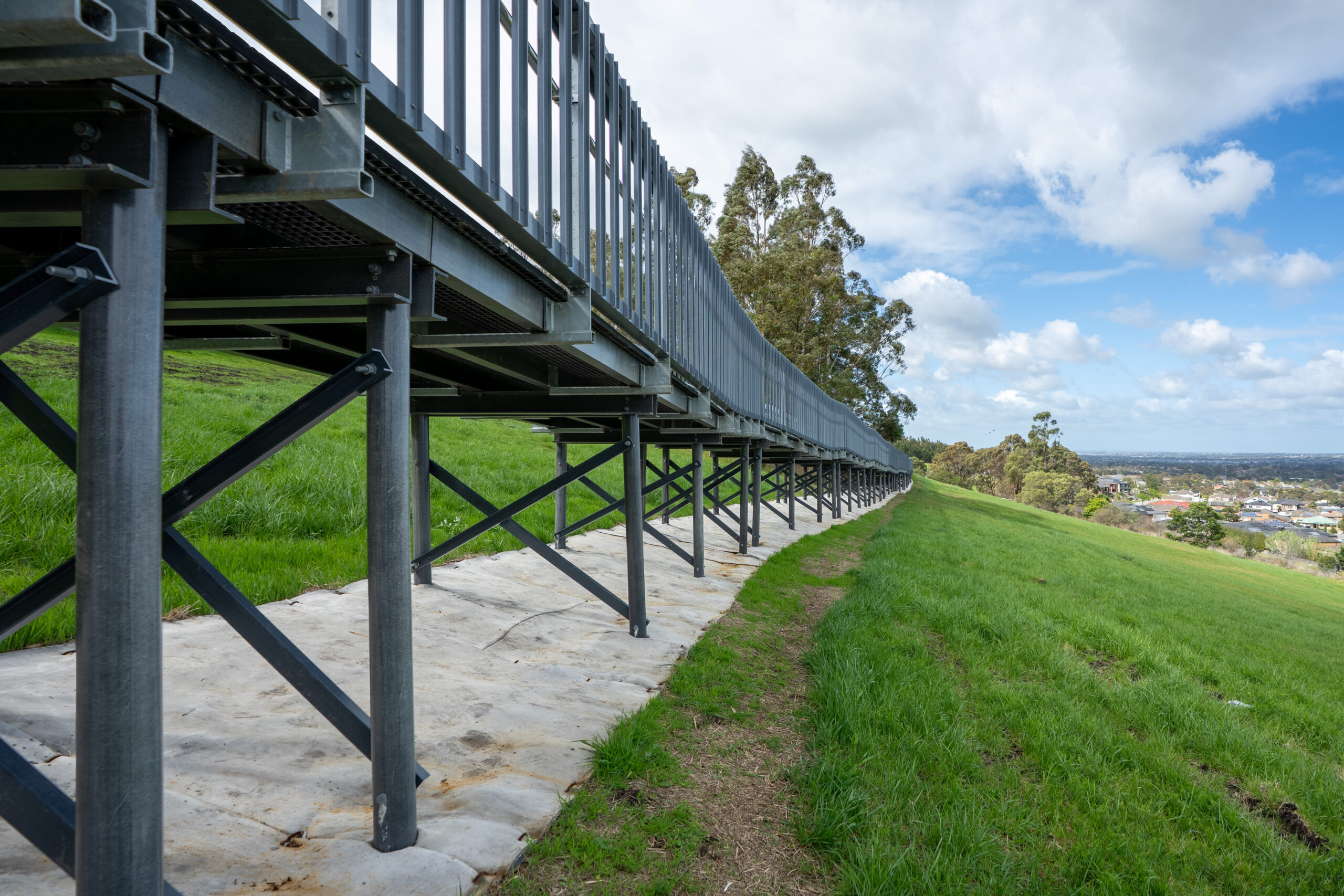
A typical DMWALK™ system may incorporate primary beams, bearers, joists, decking or grating, support posts, engineered connections, handrails, balustrades, kerbs, ramps, stairs, foundations and piles.
Depending on the application, DM Composites can provide a predominantly FRP structure or a hybrid system combining FRP with steel or concrete components.
Why Choose FRP Boardwalks?
DMWALK™ combines the inherent material advantages of FRP with project-specific structural design and modular construction.
01
FRP does not rust, making it particularly suitable for coastal, marine, wetland and high-moisture environments.
 02
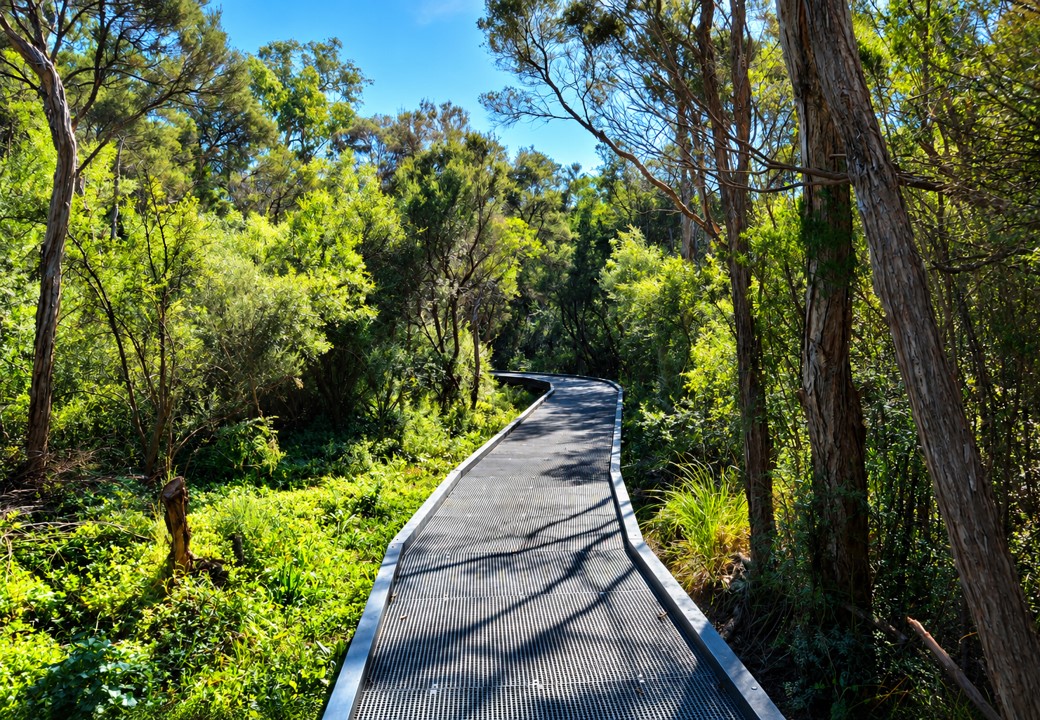
FRP structural members do not undergo the timber rot and fungal deterioration associated with prolonged moisture exposure.
 03
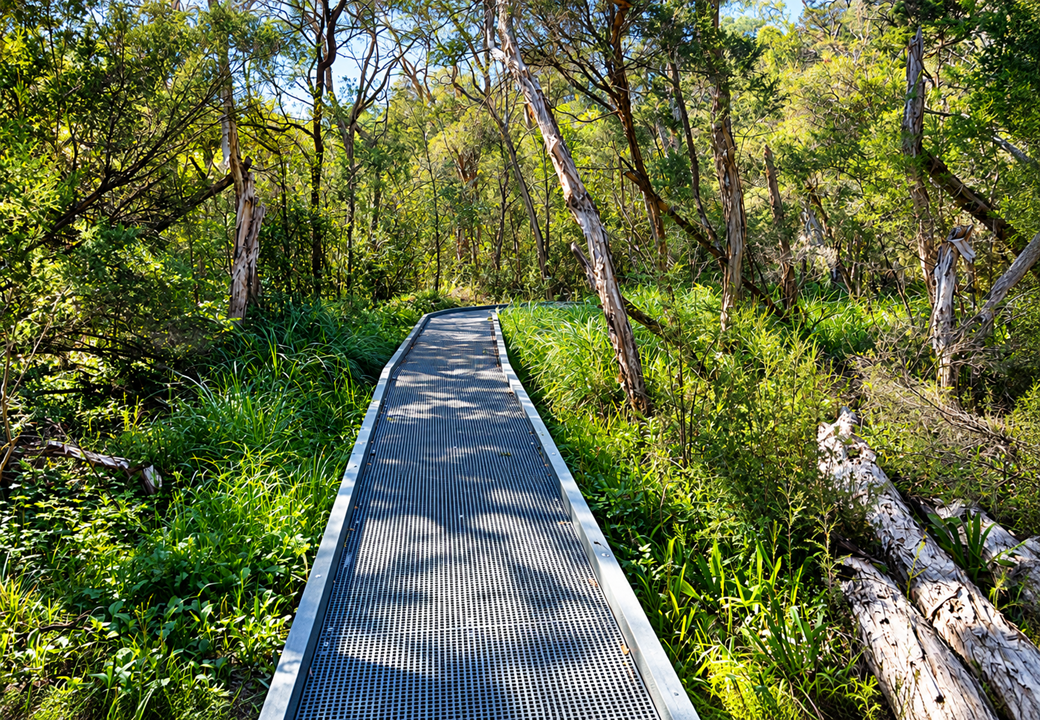
Reduced component weight can simplify transport, handling, lifting, remote-site access and installation.
 04
FRP reduces corrosion treatment, repainting and timber-preservation requirements while routine inspections remain necessary.
 05
DMWALK™ can incorporate DMGRATE™ gritted FRP decking, selected around slip resistance, accessibility and pedestrian use.
 06
Structural components can be prefabricated into transportable sections before final site assembly.
DMWALK™ FRP Boardwalk Systems
Each DMWALK™ boardwalk is configured around its intended use, location, loading, geometry and environmental requirements.
FRP beams, channels, angles and hollow sections can form primary beams, bearers, joists, posts and supporting frames.
Walking SurfaceStandard Mesh, Mini Mesh, Micro Mesh and Heavy Duty grating options for project-specific walking surfaces.
Timber-Look DeckingWPC composite decking provides a timber-inspired surface where architectural appearance is a priority.
Edge ProtectionFRP, steel or specified handrail systems can incorporate balustrades, kerbs and project-specific accessible arrangements.
FRP Boardwalk Applications
From salt-exposed coastlines to soft wetland ground, DMWALK™ systems can be configured around environmental, structural, accessibility and construction constraints.

Coastal boardwalks can be exposed to salt spray, moisture, UV radiation and aggressive environmental conditions. FRP provides inherent corrosion resistance for walking trails, beach access, dune crossings and waterfront infrastructure.

Wetlands can present soft ground, continuous moisture and restricted access. Lightweight modular components can assist installation where heavy-equipment access is limited.
DMWALK™ can provide pedestrian access through walking trails, nature reserves, conservation areas, visitor facilities, lookouts and wildlife observation areas.
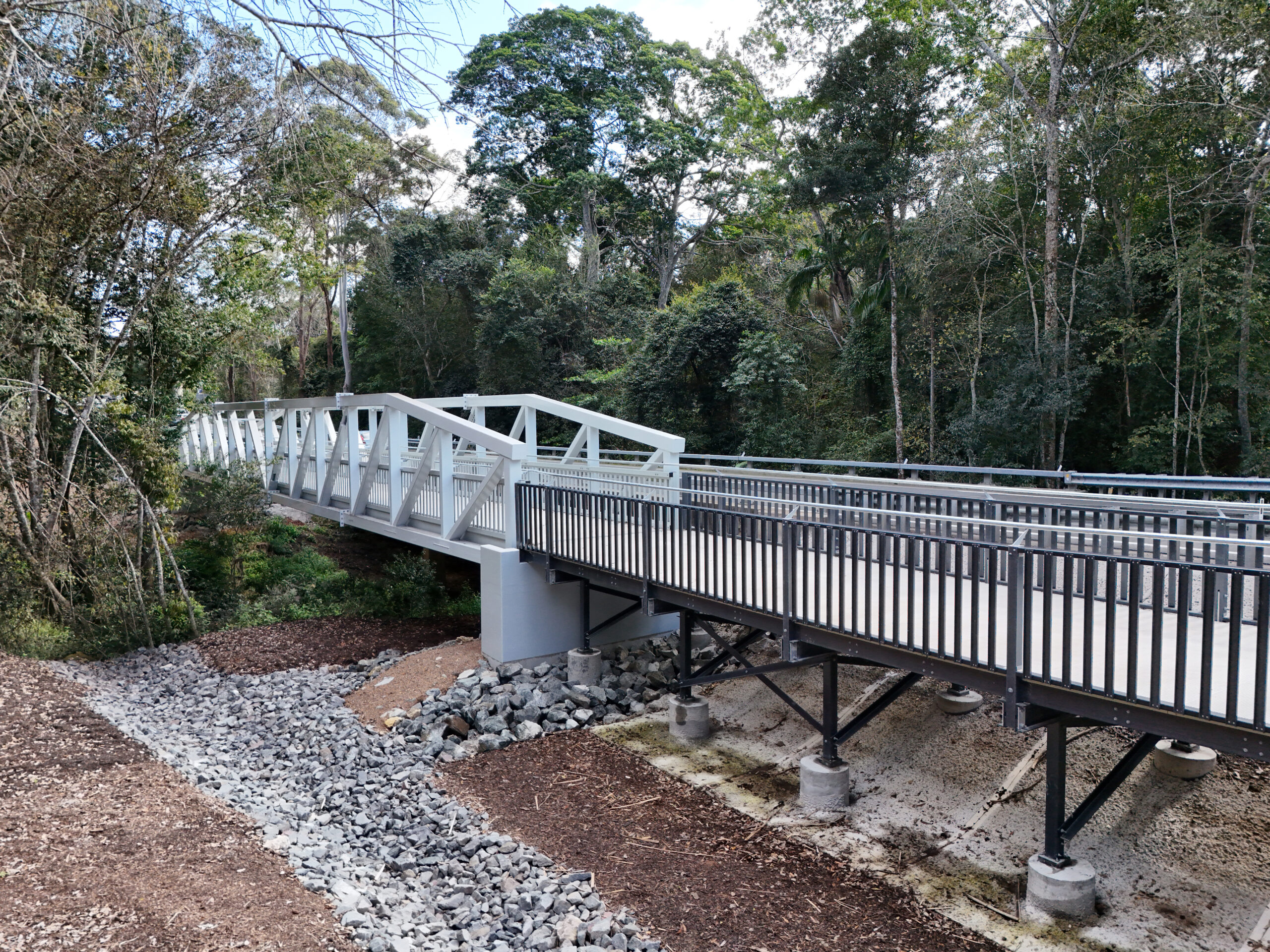
Elevated FRP boardwalks can form part of pedestrian and bicycle networks crossing waterways, wetlands, floodplains or uneven ground.
Replacing Timber Boardwalks with FRP
Many existing public boardwalks throughout Australia were constructed using treated timber.
Over time, these structures can experience deterioration caused by moisture, rot, splitting and other environmental factors. Common issues include deteriorating decking, rotting bearers and joists, damaged handrails, loose connections, repeated maintenance, structural deterioration and restricted public access during repairs.
DMWALK™ provides an alternative using FRP structural framing and corrosion-resistant decking. Existing foundations or supports may be retained where their condition and capacity can be verified through engineering assessment.
Review condition, geometry, support arrangement and available drawings.
Confirm survey, ground conditions, access constraints and environmental requirements.
Develop the FRP structure around loads, spans, accessibility and project requirements.
Manufacture structural components, decking, connections and handrails.
Remove the existing structure where required and prepare the work area.
Install new foundations or adapt suitable existing supports where approved.
Install framing, decking, handrails and associated components.
Complete inspections, QA documentation and project handover.
FRP Boardwalks vs Timber & Steel
FRP should not be treated as a direct dimensional substitute for timber or steel. Mechanical properties, connections, deflection and long-term performance require FRP-specific engineering.
| Feature | FRP | Timber | Steel |
|---|---|---|---|
| Rust | Does not rust | N/A | Can rust |
| Rot | Does not rot like timber | Possible | N/A |
| Weight | Lightweight | Relatively light | Heavy |
| Coastal Exposure | Excellent when specified correctly | Species dependent | Requires corrosion protection |
| Maintenance | Generally low | Treatment or replacement may be required | Coatings may require maintenance |
| Modular Construction | Excellent | Good | Good |
| Electrical Conductivity | Non-conductive FRP | Generally non-conductive | Conductive |
| Structural Design | FRP-specific | Timber-specific | Steel-specific |
Boardwalk Decking Options
Selection should consider accessibility, surface openings, slip resistance, loads, spans, environmental exposure and project specifications.
Conventional open mesh suitable for appropriate pedestrian and maintenance applications.
Smaller surface openings for public walkways and access applications.
Finer surface configuration for applications requiring reduced openings.
Increased structural capacity for appropriate higher-load applications.
Timber-look composite finish for architectural and recreational boardwalk applications.
FRP Boardwalk Structural Design
Pultruded FRP profiles are orthotropic, meaning their mechanical properties vary according to fibre orientation.
Structural design should consider permanent loads, pedestrian and bicycle loading, maintenance loads, wind, flood actions, buoyancy, debris impact, bending, shear, deflection, vibration, connections, bearing, foundations and environmental exposure.
For many FRP boardwalks, deflection and serviceability can govern member selection because FRP has a lower elastic modulus than structural steel.
DMWALK™ can be developed around narrow pedestrian paths, accessible routes, shared paths, elevated structures, curved alignments, multi-span structures and boardwalks incorporating platforms, ramps or stairs.
FRP Boardwalk Foundations
Foundation selection depends on geotechnical conditions, structural loads, environmental constraints and construction access.
The appropriate solution may use bored piers, driven piles, screw piles, micropiles, concrete footings, abutments or verified existing supports.

Suitable where ground conditions and construction access permit, subject to structural and geotechnical design.
Potentially suitable for wetlands, coastal areas and soft ground where geotechnical and environmental requirements allow.
May provide reduced excavation and relatively rapid installation, depending on soil conditions and access.
Can be considered where conventional piling equipment cannot access the site or space is restricted.
Concrete elements can interface with FRP framing using engineered plates, anchors and connection details.
Existing supports may be retained where condition, capacity and compatibility can be verified.
Construction in Environmentally Sensitive Areas
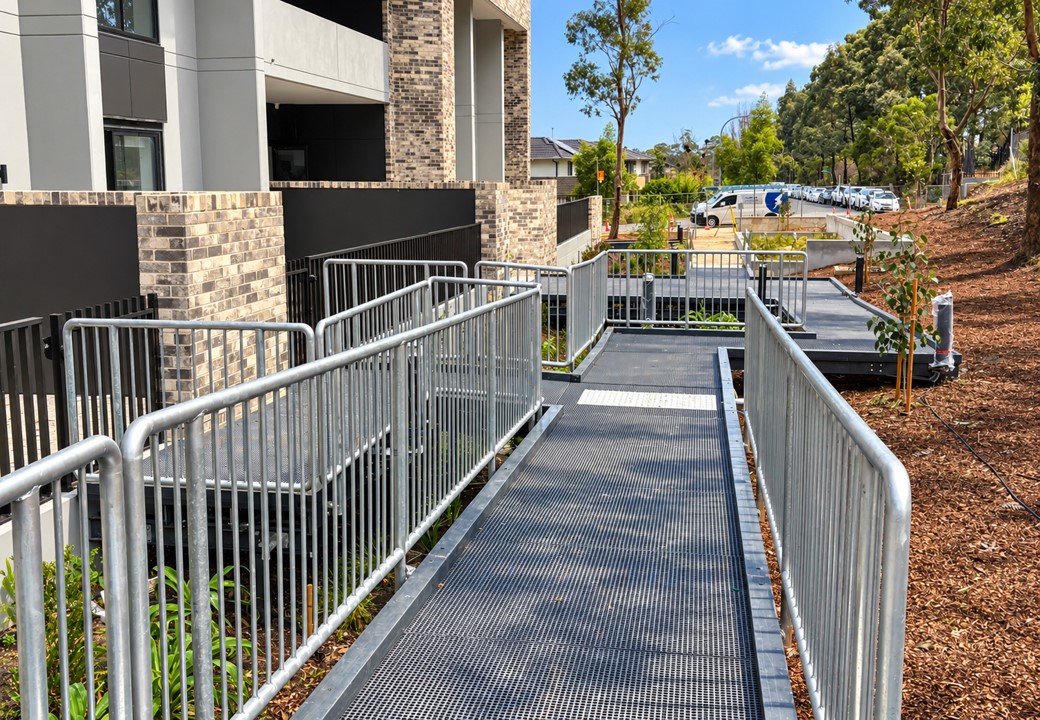
Wetlands, waterways, national parks and sensitive environments can introduce restrictions around vegetation, soft ground, water levels, access and environmental controls.

Modular FRP Boardwalk Construction
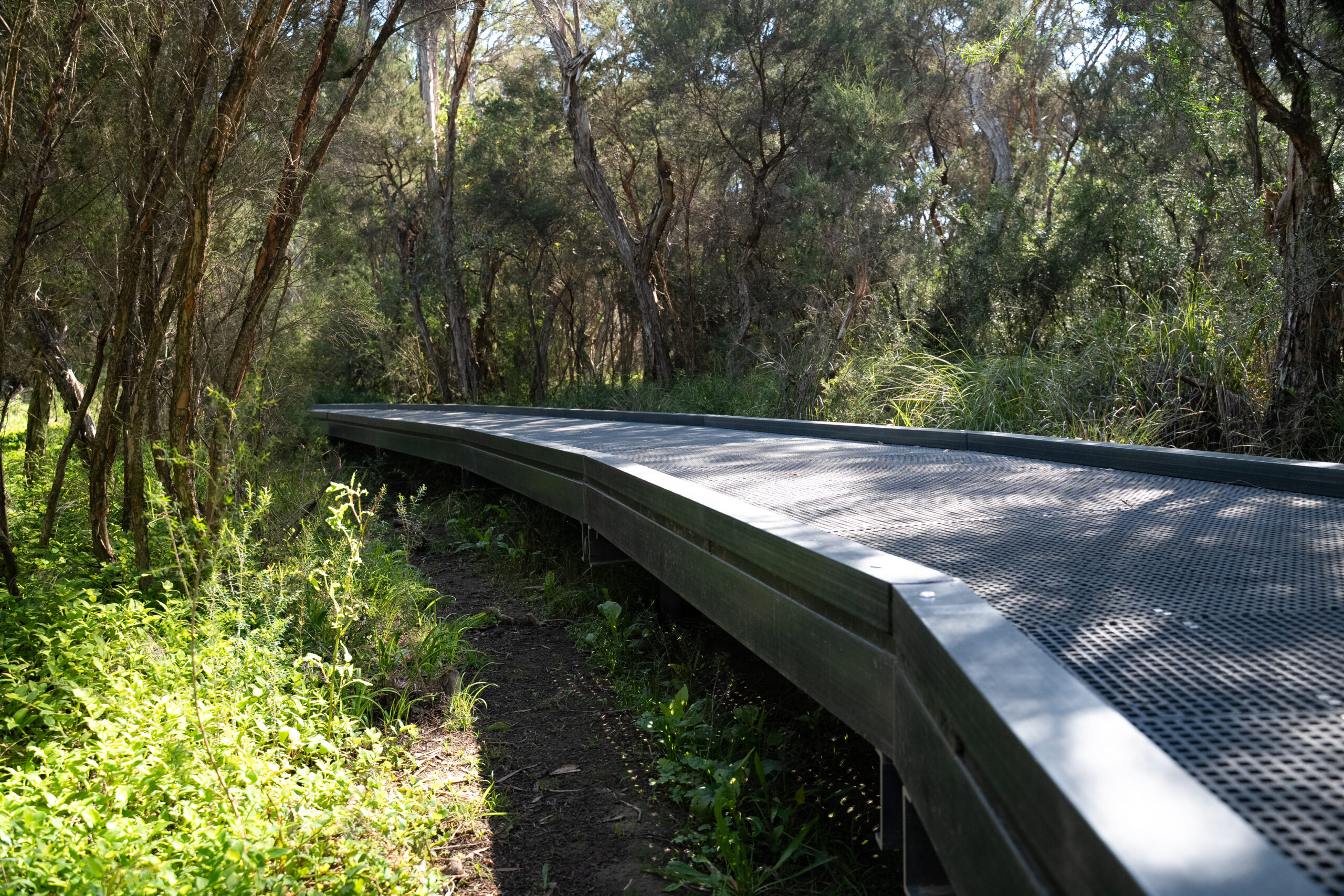
DMWALK™ boardwalks can be designed around transportable structural sections prepared before delivery to site.
Depending on project requirements, prefabricated modules may incorporate structural beams, bearers, joists, grating or composite decking, handrails, balustrades, kerbs, connection plates, stairs, landings and platform sections.
FRP Boardwalk Handrails & Balustrades
Handrail selection needs to consider pedestrian loading, fall height, accessibility, structural connections, environmental exposure and project requirements.
Flood-Resistant FRP Boardwalks
Boardwalks within floodplains, waterways and low-lying reserves can be exposed to significant hydraulic forces during flood events.
FRP boardwalks can be designed for flood-prone environments where appropriate structural and hydraulic engineering is undertaken. Where required, specially engineered removable or collapsible handrail systems can also be incorporated.
FRP Boardwalk Standards & Compliance
DMWALK™ boardwalks are designed according to applicable project requirements and relevant Australian Standards.
Structural design actions including applicable permanent, imposed, wind and other actions.
Relevant provisions may apply where a boardwalk forms part of a bridge or bridge-like structure.
Accessibility requirements may apply to paths, ramps, crossfalls, openings, handrails and transitions.
May be relevant to applicable access and maintenance platforms, walkways and stairways.
May be relevant to walking tracks, boardwalks, stairs and associated infrastructure in natural environments.
Relevant to project requirements for pedestrian surface slip-resistance classification.
Relevant provisions may apply where reinforced concrete foundations, piers or abutments form part of the structure.
The applicable standards depend on the intended use, location, structural arrangement and accessibility requirements of the particular project.
Accessibility & Public Safety
Public boardwalks must be designed around their intended users and the applicable accessibility and safety requirements.
Boardwalk Design Life & Durability
DMWALK™ systems can be engineered around project-specific design-life requirements.
FRP's inherent resistance to corrosion and timber rot can provide substantial advantages in wet and aggressive environments. However, the service life of a complete boardwalk also depends on foundations, connections, decking, handrails, installation quality, inspection and maintenance.
FRP Boardwalk Design & Construction Process
DM Composites can manage complete FRP boardwalk projects from initial design through construction and handover.
Review drawings, specifications, scope, environment, site information and delivery requirements.
Confirm levels, alignment, existing structures, ground conditions, services and access constraints.
Develop framing, decking, handrails, connections, foundations and accessibility requirements.
Prepare fabrication drawings, schedules, connection details and structural components.
Establish access, environmental controls, safety measures and temporary works.
Construct piles, piers, footings, abutments or other supporting elements.
Install framing, connections, decking, handrails and associated components.
Complete inspections, quality documentation, as-built information and handover requirements.
Project Delivery
DM Composites supports engineered supply packages, complete design and construction, and construction from issued documentation.
For contractors requiring an engineered FRP boardwalk package.
Complete integrated boardwalk delivery from engineering through to handover.
Construction in accordance with design documentation already issued for construction.
FRP Boardwalk Projects
Explore selected DM Composites boardwalk projects demonstrating FRP structural framing, modular construction, accessible pedestrian routes and long-term public infrastructure.

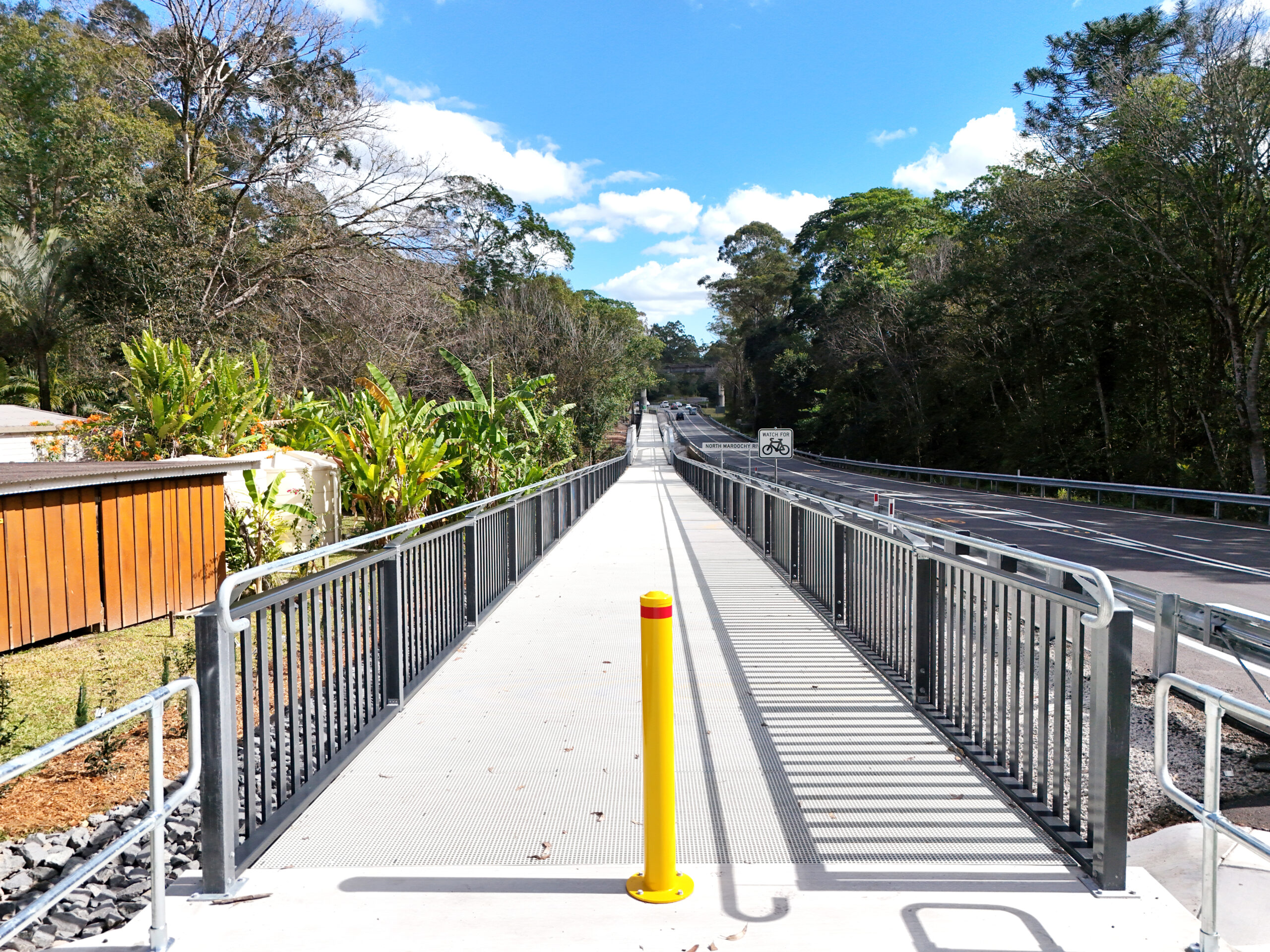
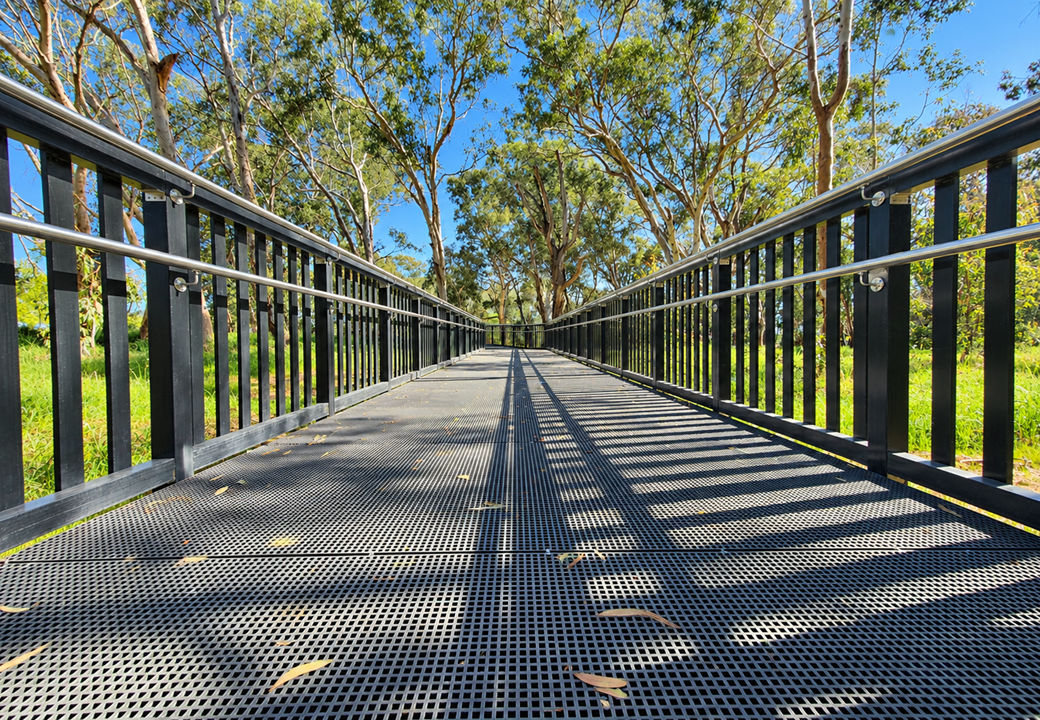
Elevated FRP boardwalk infrastructure supporting durable public pedestrian access.
View Project →
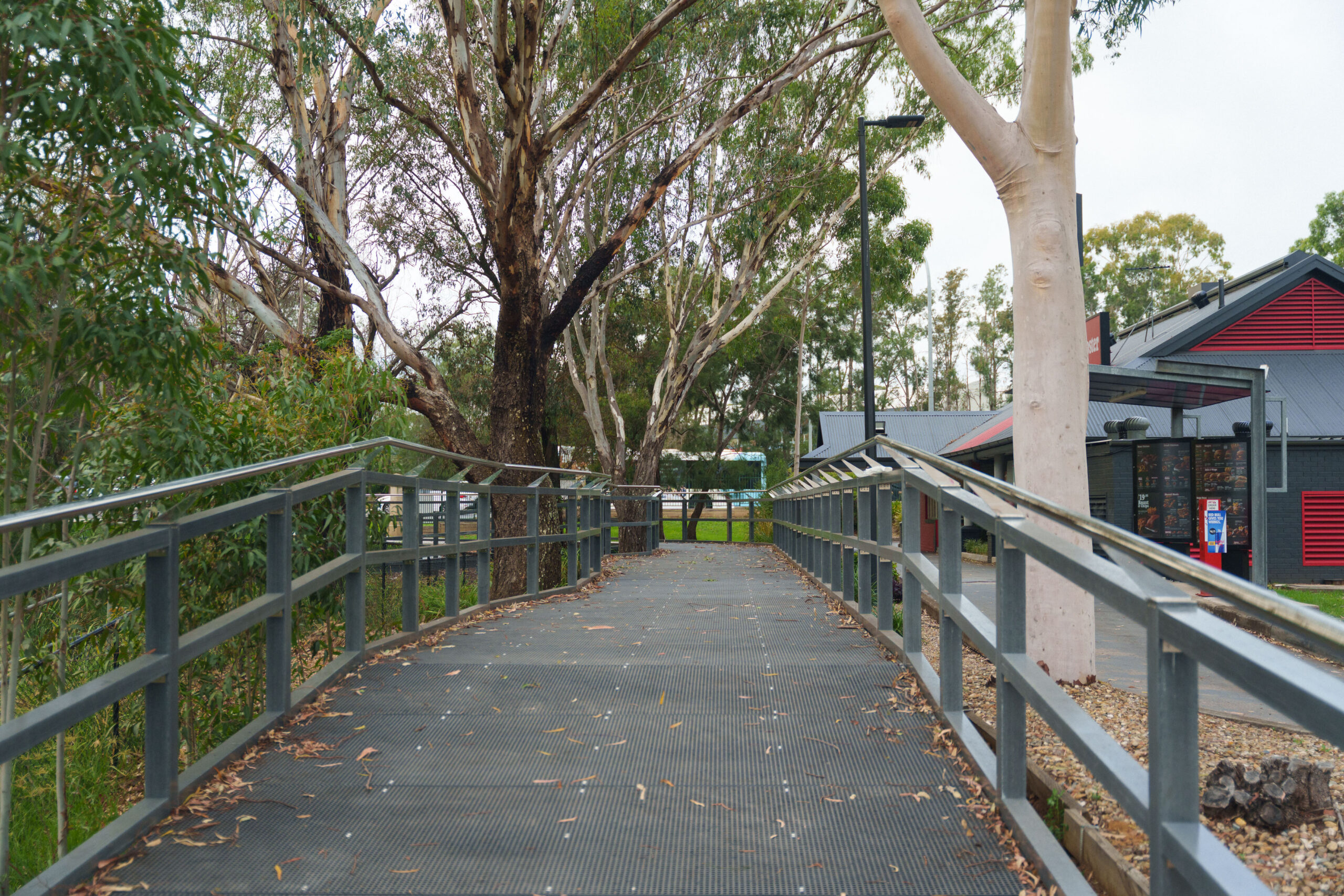
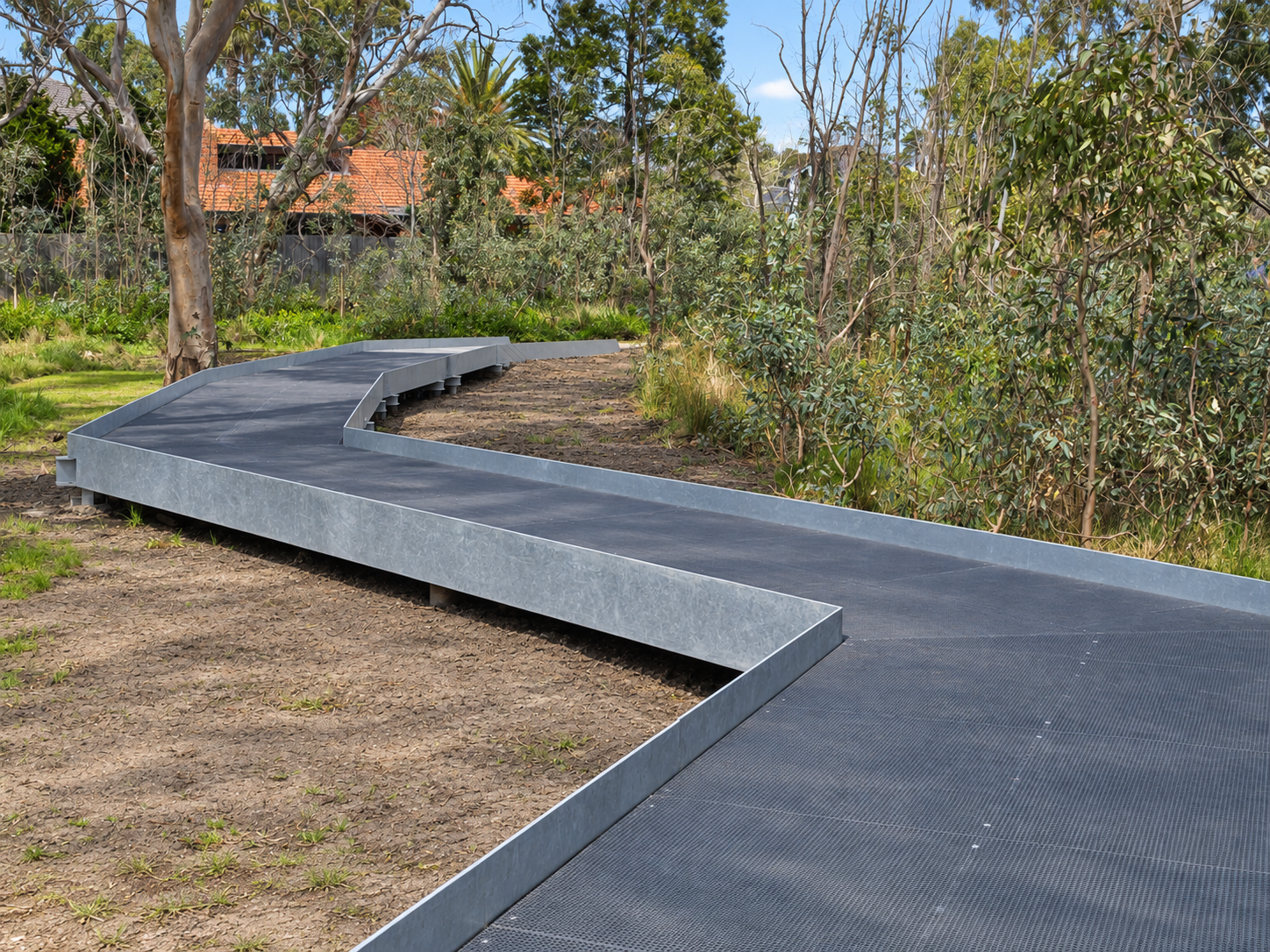
Prefabricated FRP boardwalk providing safe all-weather pedestrian access through a vegetated reserve.
View Project →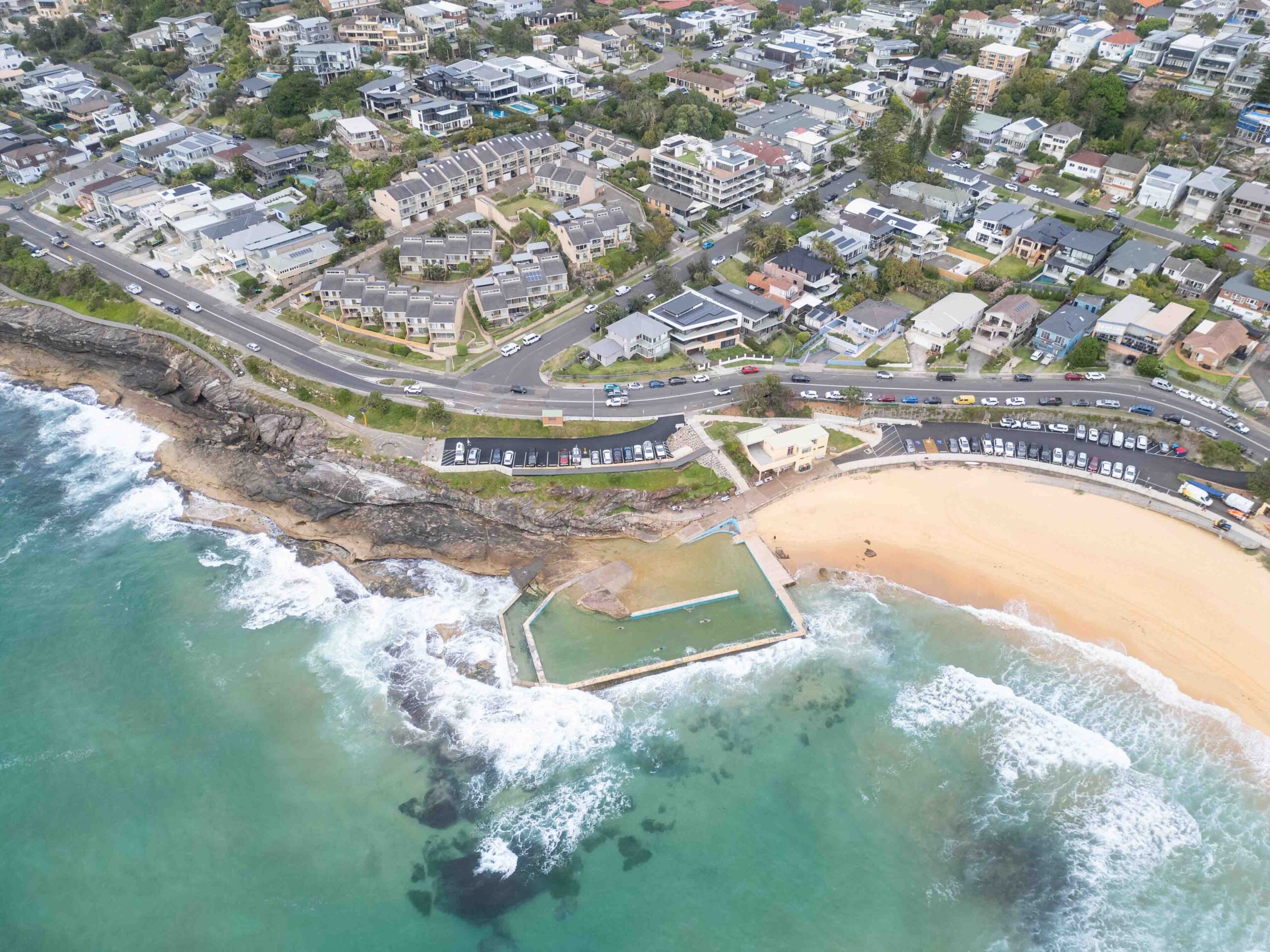
Public coastal pedestrian infrastructure supporting improved access through a demanding marine environment.
View Project →Why DM Composites?
Our capability extends beyond supplying individual FRP components. We understand how the complete boardwalk must come together.
Structural profiles, grating, decking, handrails and complete engineered composite structures.
Project-specific boardwalk solutions developed from concept drawings, tender documentation or existing designs.
Structural members, decking, connections and modular assemblies can be prepared before delivery.
Construction capability can include foundations, structural installation, decking and handrails.
Engineering, procurement, fabrication and construction coordinated through one delivery team.
Who We Work With
DM Composites can become involved during concept development, tendering, value engineering, detailed design, procurement or construction.
Technical Documentation
Depending on the project, DM Composites can provide technical information to assist with boardwalk design, specification, procurement and construction.
Frequently Asked Questions
Common questions about boardwalk materials, coastal exposure, wetlands, accessibility, flooding, foundations and project delivery.
An FRP boardwalk is a pedestrian access structure incorporating Fibre Reinforced Polymer structural components, decking or a complete FRP superstructure.
FRP can provide significant advantages where moisture, rot and ongoing maintenance are important considerations. The appropriate material still depends on structural requirements, environment, budget, appearance and whole-of-life considerations.
FRP itself does not rust like steel. Metallic fixings or other components must still be selected for the applicable environmental exposure.
FRP structural components do not undergo timber rot or fungal decay, making them attractive for moisture-exposed environments.
Yes. Correctly specified FRP boardwalks are particularly suited to many coastal environments because of their inherent corrosion resistance.
Yes. Lightweight components and modular construction can provide advantages in wetlands and environmentally sensitive areas. The construction methodology must still respond to site-specific constraints.
Yes. Curved or segmented alignments can be developed using project-specific framing, connections and coordinated decking layouts.
Yes. FRP boardwalks can be engineered for pedestrian and bicycle traffic, including shared-path applications, where required by the project.
Yes, where the boardwalk is specifically engineered for the required vehicle loading. Standard pedestrian boardwalks should not automatically be assumed suitable for vehicles.
Yes, subject to appropriate structural and hydraulic engineering considering flood levels, water velocity, buoyancy, debris, scour and foundation stability.
DMWALK™ can incorporate DMGRATE™ grating with gritted surfaces. The appropriate product and surface finish should be selected around the required use and slip-resistance performance.
Yes. Boardwalks can be designed around accessible pedestrian routes where required, considering width, gradients, crossfalls, openings, transitions, handrails and landings.
Yes. DMWALK™ can incorporate DMWOOD™ WPC decking where a timber-inspired walking surface is preferred.
Potential systems include bored concrete piers, driven piles, screw piles, micropiles, concrete footings and engineered connections to existing structures.
Yes. DM Composites can develop a complete replacement structure or, where verified as suitable, a new FRP superstructure supported on retained foundations.
Yes. Structural frames, decking panels, handrails and connections can be prepared or assembled off site before final installation.
Yes. DM Composites provides Design & Supply, Design & Construct and Construct Only services for FRP boardwalk projects.
Yes. DM Composites supplies and delivers boardwalk and public-infrastructure solutions across Australia and New Zealand, with delivery arrangements depending on the project scope and location.
Need an FRP Boardwalk for Your Project?
Whether you are replacing an existing timber boardwalk, developing coastal access, upgrading a shared path or providing pedestrian access through wetlands, our team can review the requirements and develop an appropriate DMWALK™ solution.
Enter your company details to access this resource.